
Why These Stocks Could Thrive Under Trump’s Housing Affordability Plan
As the White House targets high mortgage rates and Wall Street landlords, a new wave of liquidity prepares to lift the residential real estate market.


The American housing market finally broke its silence this month. For over two years, high interest rates and inflated prices kept first-time buyers on the sidelines while existing homeowners clung to their low-interest pandemic mortgages. This lock-in effect effectively froze the market. However, a single directive from the Oval Office recently shook up the financial sector. President Donald Trump announced his plan to inject $200 billion into mortgage-backed securities, signaling a massive effort to force borrowing costs down and revitalize the American dream of homeownership.
“Because I chose not to sell Fannie Mae and Freddie Mac in my First Term, a truly great decision, and against the advice of the ‘experts,’ it is now worth many times that amount — AN ABSOLUTE FORTUNE — and has $200 BILLION DOLLARS IN CASH. Because of this, I am instructing my Representatives to BUY $200 BILLION DOLLARS IN MORTGAGE BONDS. This will drive Mortgage Rates DOWN, monthly payments DOWN, and make the cost of owning a home more affordable,” wrote Trump on Truth Social.
Also Read: Small Digital Health Stock Charts Bold Path to $250 Million Revenue by 2030
The strategy targets the very heart of the secondary mortgage market. By instructing Fannie Mae (OTC: FNMA) and Freddie Mac (OTC: FMCC) to utilize their massive cash reserves for mortgage bond purchases, the administration aims to compress the spread on mortgage rates. Investors immediately recognized the potential. While the 30-year fixed mortgage recently slid toward the 6% mark, the equity markets began pricing in a massive rebound for companies that thrive on transaction volume. Despite a minor cooling period over the last 48 hours, several key players in the mortgage and real estate sectors look ready to capitalize on this government-led liquidity injection.
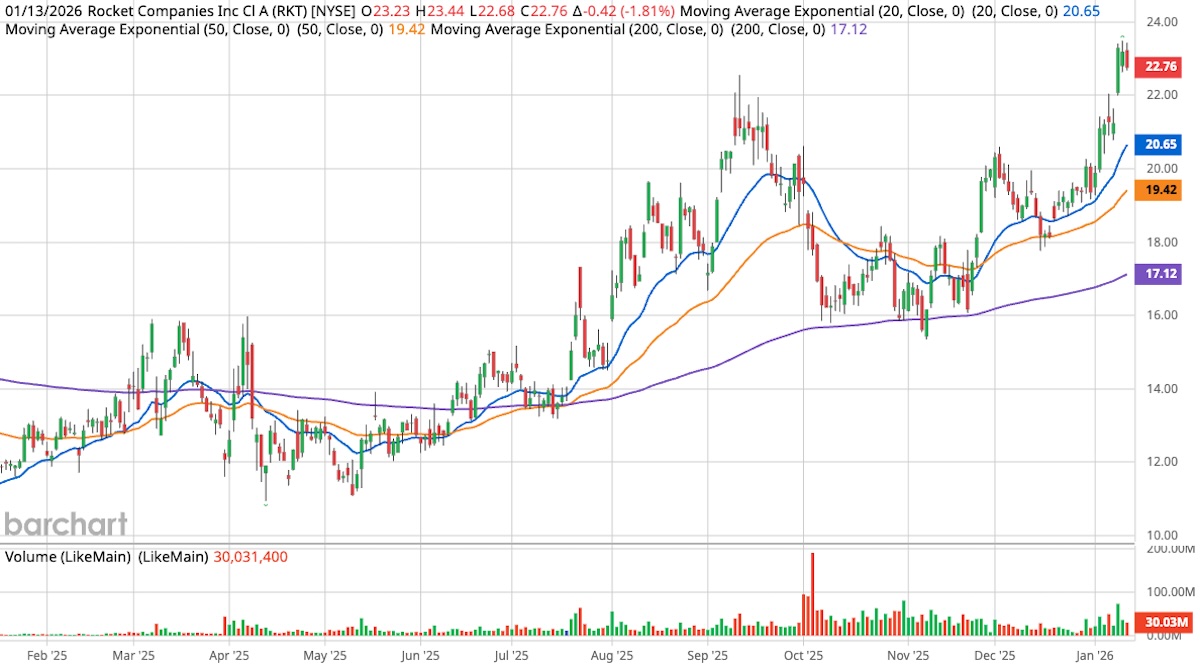
Rocket Companies (NYSE: RKT) stands at the forefront of this potential boom. As a premier digital mortgage platform, Rocket lives and breathes on refinancing cycles. When rates drop, the Detroit-based lender usually sees its application pipelines overflow. Although the stock dipped 1.81% on Tuesday to close at $22.76, its recent trajectory tells a much more aggressive story. Since Trump floated the mortgage-bond purchase plan, RKT shares have surged as much as 10.4%. The company has spent the last year expanding its ecosystem, acquiring Redfin and Mr. Cooper to create a vertically integrated machine that handles everything from the initial home search to the final closing.
Unlocking the Refinance Goldmine
The market anticipates that a drop in rates below the 6% threshold will trigger a refinancing wave not seen since 2021. Analysts at JPMorgan Chase (NYSE: JPM) recently resumed coverage on Rocket with a “Neutral” rating and a $24 price target, acknowledging the company’s broader reach. While JPM remains cautious about how much of this good news the market has already baked in, the sheer scale of the government’s intervention could push volume past current estimates.
Jefferies analyst Matthew Hurwit recently highlighted the broader implications of these policy shifts, noting:
“While Fed cuts do not mechanically translate into lower mortgage rates, easing policy expectations, lower volatility, and improved affordability dynamics are incrementally supportive for mortgage demand and originator earnings power.”
This optimism extends to other mortgage-heavy names like LoanDepot (NYSE: LDI). Like its larger competitors, LoanDepot saw its share price spike following the White House announcement. Shares of LDI have risen as much as 30% since the plan’s inception, though they surrendered some gains on Tuesday, sliding 4.64% to $2.67. LDI’s 14% pullback over the last two sessions might actually offer a strategic entry point for investors who believe the administration will follow through on its liquidity promises.
Also Read: Why Big Investors Who Can’t Buy Crypto Are Gobbling Up These Stocks Instead
iBuyers and the Liquidity Influx
The most dramatic price action occurred among the iBuyers, companies that buy homes directly from consumers to flip them. Opendoor (NASDAQ: OPEN) and Offerpad Solutions (NYSE: OPAD) both saw their stock prices surge last week. The logic is simple: lower rates reduce the cost of carrying inventory and accelerate the speed at which these companies can offload homes to new buyers. Offerpad, in particular, saw its stock skyrocket as much as 84% following the news.
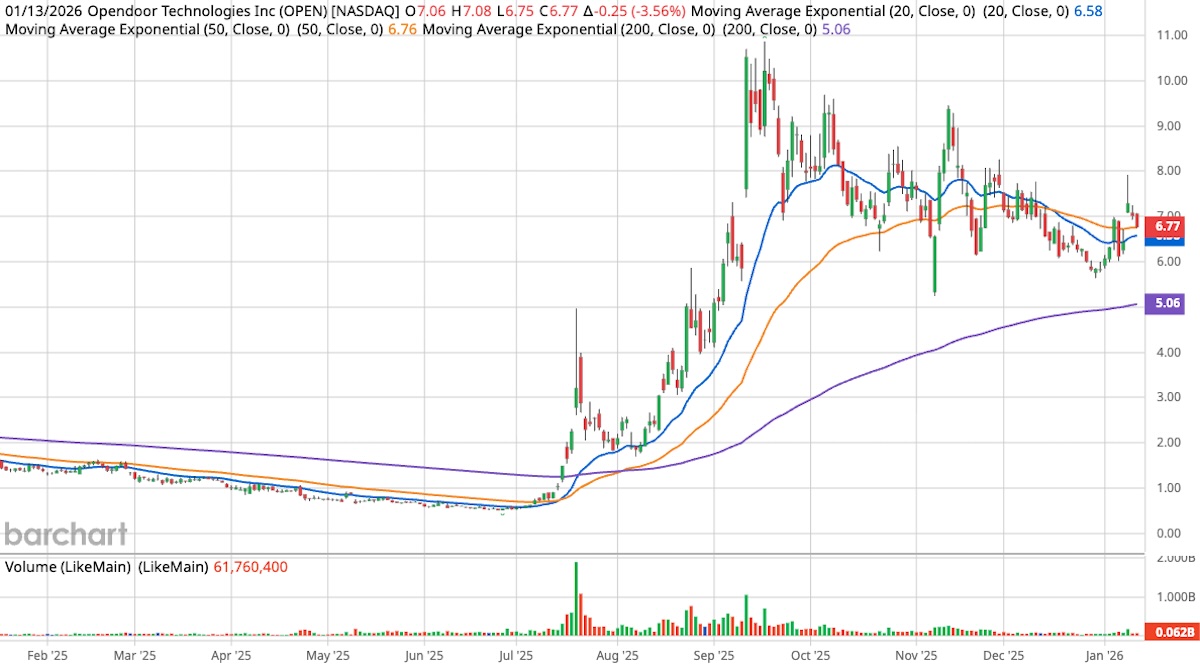
However, the last two trading sessions served as a stark reminder of the volatility inherent in these small-cap names. Offerpad plunged 10.1% on Tuesday to close at $1.60, marking a 40% decline from its recent peak. Similarly, Opendoor fell 3.56% on Tuesday to $6.77, sitting about 14% below its post-announcement high. Despite this retreat, both companies stand to benefit from Trump’s proposal to sideline institutional investors. By removing massive Wall Street firms from the bidding wars for single-family homes, the administration effectively clears the path for consumer-to-consumer moves, which provide the lifeblood for the iBuyer business model.
Commercial players are also finding their footing in this shifting landscape. Walker & Dunlop (NYSE: WD) closed Tuesday at $63.05, down 1.61% for the day. While primarily known as a commercial real estate capital provider, the company manages a diverse portfolio that includes multifamily housing. Since the affordability plan went public, WD shares have climbed as much as 7.8%. The company’s stable, fee-based servicing model offers a different kind of resilience compared to the high-beta mortgage originators, providing a moat even if rate volatility persists in the short term.
Builders and the Institutional Shift
The residential construction sector currently acts as the wild card in this environment. The iShares U.S. Home Construction ETF (CBOE: BZX) has already outpaced the S&P 500 (SPX) this year, fueled by hopes for a robust spring selling season. While lower rates help buyers, the Trump administration is also eyeing the supply side. Government officials have hinted at a “carrots-and-sticks” approach to ensure builders increase production without gouging consumers.
This power shift could come at the expense of traditional Wall Street landlords. The administration’s talk of banning firms like Blackstone (NYSE: BX) from buying single-family homes represents a fundamental change in housing policy. By prioritizing Main Street over Wall Street, the plan aims to return inventory to individual families. Federal Housing Finance Agency (FHFA) Director Bill Pulte recently emphasized the leverage the government holds over these market dynamics.
In an interview with Barron’s, Pulte stated:
“Fannie and Freddie control a lot of liquidity, and there’s a certain price to our liquidity.”
While the broader market, including the S&P 500, processes these rapid changes, the housing sector remains the focal point of the current “Trump Trade.” The recent pullbacks in names like Rocket, Opendoor, and LoanDepot suggest that the initial euphoria has transformed into a more calculated evaluation of the risks. Investors now weigh the potential for increased demand against the risk of tighter profit margins for builders. If the White House successfully executes its $200 billion bond purchase, the current dip in these share prices may look like a minor footnote in a much larger story of market recovery.
Small Cap News Movers & Winner Deep Dive – By WealthyVC.com
We scan over 10,000 publicly listed stocks across all seven North American exchanges to uncover the market-moving news that actually matters—focusing on high-quality, liquid, growth-oriented companies in sectors attracting serious capital, like AI, blockchain, biotech, and consumer tech.
Each week, we publish Small Cap News Movers, a curated roundup of small and micro-cap stocks surging on meaningful catalysts. We break down what’s driving the move, tap into rumors swirling on social media, and surface sharp insights from both industry experts and retail sleuths.
From this list, we select one standout stock for our Small Cap Winner Deep Dive, released the next day, where we take a closer look at the fundamentals, narrative, and technicals that suggest this winner could keep running.
Powered by our proprietary 4-element, AI-driven analysis system, our goal is simple: cut through the noise, remove the emotion, and help investors dominate the small-cap market with momentum-driven strategies—completely free.
Sign up for email alerts to get the moves before our social media followers.
Read Next: Why Nvidia’s Tech Investments Could Transform the Entire AI Innovation Ecosystem
Join the Discussion in the WVC Facebook Investor Group
Do you have a stock tip or news story suggestion? Please email us at: invest@wealthyvc.com.
Disclaimer: Wealthy VC does not hold a position in any of the stocks, ETFs or cryptocurrencies mentioned in this article.