
Private Credit Crisis Deepens as More Funds Move to Block Investor Withdrawals
Major asset managers invoke liquidity gates amid investor concern over software-sector valuations and credit quality


The private credit market is experiencing a significant increase in redemption requests, leading several prominent fund managers to limit investor withdrawals. Cliffwater Corporate Lending Fund, a $32.5 billion investment vehicle, notified investors Wednesday that it would cap redemptions at 7% after receiving requests to return nearly 14% of its shares. While the firm honored more than its 5% quarterly guarantee, the surge in exit requests mirrors a broader trend across the $1.8 trillion sector.
The tightening liquidity comes as JPMorgan Chase (NYSE: JPM) adopts a more cautious stance on the industry. The bank recently marked down the value of certain loans linked to private credit funds, particularly those involving middle-market software companies. Shares of JPMorgan closed Wednesday at $287.52, down 0.4% for the day and 10.8% year-to-date. These markdowns effectively reduce the amount of capital banks lend to private credit groups against their portfolios, potentially constraining the industry’s ability to originate new debt.
Asset Managers Invoke Liquidity Gates
Blackstone (NYSE: BX) and BlackRock (NYSE: BLK) are among the large-scale managers navigating these redemption cycles. Blackstone recently allowed nearly 8% of its flagship Blackstone Private Credit Fund (Bcred) to redeem, exceeding its standard 5% cap. To facilitate these withdrawals, the firm utilized capital from its own balance sheet and contributions from executives. Blackstone shares ended the session at $107.25, reflecting a 30.4% decline since the start of the year.
BlackRock has maintained a stricter approach with its $26 billion HPS Corporate Lending Fund, sticking to a 5% withdrawal limit despite receiving $1.2 billion in redemption requests. Shares of BlackRock settled at $951.17 on Wednesday, down 11.1% year-to-date. Meanwhile, Blue Owl Capital (NYSE: OWL) permanently halted redemptions at one of its retail-focused debt funds in February. The asset manager now faces a securities class action lawsuit following the move. Blue Owl shares fell 4.8% Wednesday to $9.02, bringing its year-to-date losses to 39.6%.
The friction in the market stems from a structural mismatch. Private credit funds often provide five-to-seven-year loans to corporate borrowers but offer quarterly liquidity windows to their investors. When market sentiment shifts, these managers must balance the needs of exiting investors with the illiquid nature of the underlying assets.
Valuation Pressure and Software Exposure
A primary driver of the current anxiety is the private credit market’s heavy exposure to the software sector. Many of these loans were underwritten during a deal wave in 2021, and some investors now worry that artificial intelligence disruptions could erode the repayment capacity of middle-market software firms. Underwriting standards in direct lending have faced scrutiny as default risks rise.
The pressure has extended to the broader peer group. Shares of KKR (NYSE: KKR)) closed at $87.13, down 31.7% year-to-date, despite the firm raising a record $129 billion in capital during 2025. Ares Management (NYSE: ARES) saw its shares retreat to $103.46, a 36% decline this year. Apollo Global Management (NYSE: APO) has followed a similar trajectory, with its stock price closing at $106.10, down 26.7% for the year.
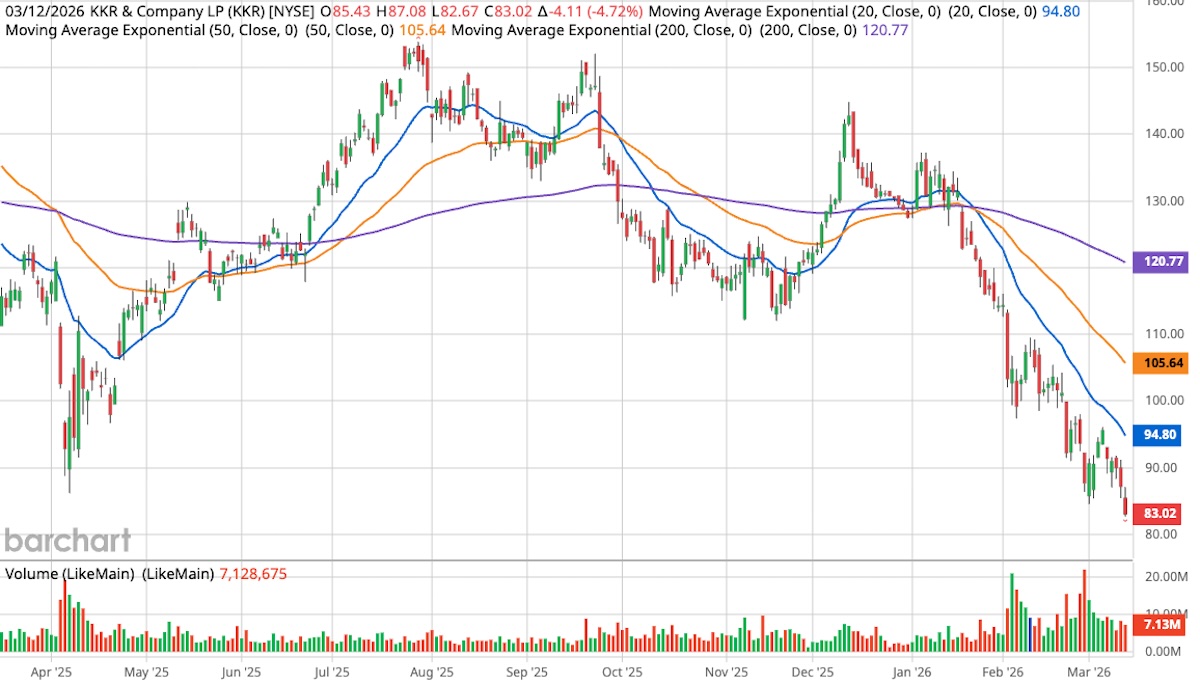
John Davies, CIO at Astoria Portfolio Advisors, noted the sharp divergence between stock performance and company fundamentals. He pointed out that while firm revenues and assets under management have grown, the equity prices are pricing in macro risks.
Regarding the sector’s recent volatility, Davies stated:
“I think the bigger concern I have is more about what’s going on in the private equity and private credit space where, you know, if you look at like, you know, Blackstone, KKR, Blue Owl, you know, some of these stocks are down, you know, 30, 40% in the last three months.”
Differing Perspectives on Systemic Risk
The current market conditions have invited comparisons to the 2008 financial crisis. Lloyd Blankfein, the former CEO of Goldman Sachs (NYSE: GS), recently commented on the $1.8 trillion market, noting signs of excess. Goldman Sachs shares closed Wednesday at $823.76, down 6.3% year-to-date.
Discussing the current atmosphere on a recent podcast, Blankfein remarked: “It sort of smells like that kind of [2008 crisis] moment again. I don’t feel the storm, but the horses are starting to whinny in the corral.”
Veteran fund manager George Noble also raised alarms about the pattern of fund managers blocking redemptions. Noble suggested that the behavior in the sector echoes the early signals of the 2007 securitized debt crisis.
In a post on X, Noble wrote:
“We’re watching a financial crisis unfold in real time. The last time funds started blocking investors from getting their money back, Bear Stearns collapsed six months later. When the WORLD’S LARGEST ASSET MANAGER starts blocking investors from getting their money back, that’s not noise. That’s an alarm.”
Conversely, many industry participants view the current situation as a normal repricing. Proponents of the sector note that the credit spread between double-B and triple-C rated debt currently sits at 750 basis points, an elevated level, but still below historic panic zones.
Large managers like Blackstone and BlackRock argue that their diversified business models allow them to weather credit cycles. For instance, while Blackstone’s credit fund faces redemptions, its flagship real estate fund recently reported its strongest investor inflows in years.
We’re watching a financial crisis unfold in real time.
The last time funds started blocking investors from getting their money back, Bear Stearns collapsed six months later.
In 2007, BNP Paribas froze €1.6 billion in funds.
Bear Stearns declared 2 funds “essentially… pic.twitter.com/Cu1tuex7UV
— George Noble (@gnoble79) March 10, 2026
Structural Challenges in a Maturing Market
Data from the International Monetary Fund suggests that the financial health of private credit borrowers is weakening. By the end of 2024, more than 40% of private credit borrowers reported negative free operating cash flow. These companies often rely on lender forbearance or accounting flexibility to remain solvent.
The entry of retail investors into the asset class has also changed the dynamic. In August, an executive order opened 401(k) plans to alternative assets, including private credit. Critics argue that pushing these illiquid products toward everyday investors at a time of rising defaults increases the risk of loss for retirement savers. Unlike public stocks, losses in private credit can take months or years to appear on statements due to infrequent valuation cycles.
The industry remains in a period of transition as it faces its first full-blown default cycle. While some analysts believe the private markets bubble is beginning to burst, others maintain that the strong capital reserves held by firms like KKR, which has $126 billion in dry powder, will provide a necessary buffer. Whether the current redemption wave is a temporary setback or a deeper reckoning depends on the stability of underlying valuations in the coming quarters.
Read Next: The Biggest Short Squeezes of All-Time
Subscribe to our Free Email Newsletter to receive our weekly in-depth market analysis and winning stock picks delivered directly to your inbox.
Join the Discussion in the WVC Facebook Investor Group
Do you have a stock tip or news story suggestion? Please email us at: invest@wealthyvc.com.
Disclaimer: Wealthy VC does not hold a position in any of the stocks, ETFs or cryptocurrencies mentioned in this article.