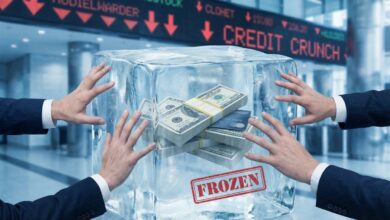
The Biggest Short Squeezes of All-Time
When the bears get backed into a corner, the exit door shrinks. Here is how some of the most famous market maneuvers turned the tables on Wall Street.

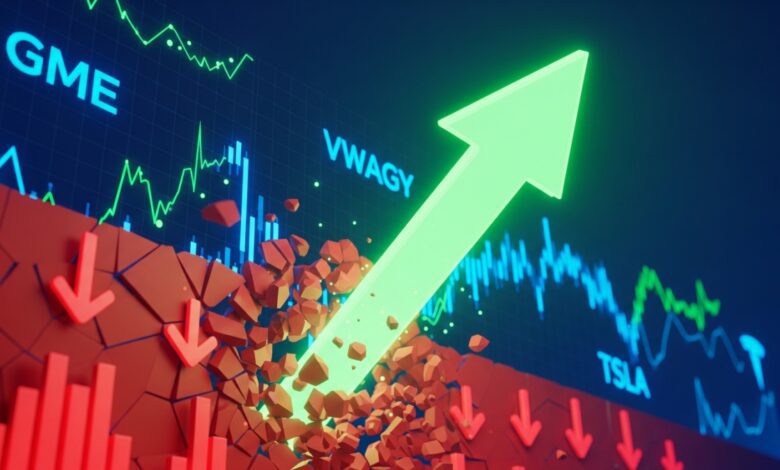
Most investors buy a stock because they believe the price will go up. Short sellers do the opposite. They borrow shares they do not own, sell them at the current price, and hope to buy them back later at a lower price to return to the lender. If the stock drops, they pocket the difference. If the stock climbs, however, the math turns dangerous. Because a stock price can theoretically rise forever, the potential for loss is infinite. A short squeeze occurs when a rising stock price forces these sellers to buy back shares to limit their losses. This rush to the exit creates a feedback loop: the more they buy, the higher the price goes, forcing even more sellers to cover.
These events often represent the most volatile moments in financial history. They transform boring balance sheets into battlegrounds, sometimes pitting billionaires against each other or retail investors against institutional giants. Understanding these squeezes offers a window into how market mechanics, human psychology, and liquidity can collide to create financial chaos.
The Grocery Store Gambit
In 1923, Clarence Saunders, the founder of Piggly Wiggly, orchestrated one of the first major squeezes in American history. Saunders had revolutionized the grocery industry by introducing self-service aisles, but he found his company’s stock under attack by short sellers on the New York Stock Exchange. He decided to fight back by cornering the market. Using his own capital and $10 million in loans, Saunders purchased nearly every available share of his own company.
By March 1923, Saunders owned all but 1,128 of the company’s outstanding shares. He then called for the short sellers to deliver the stock they owed him. With virtually no shares available for purchase on the open market, the shorts were trapped. However, the exchange stepped in and suspended trading, eventually allowing the short sellers more time to settle their positions. While the squeeze technically worked, the suspension meant Saunders could no longer sell his massive hoard of shares on a public exchange. He ended up with a mountain of debt and eventually filed for bankruptcy, proving that even a successful squeeze can ruin the person who starts it.
The Porsche-Volkswagen Infinity Squeeze
The most famous example of a structural squeeze occurred in 2008 involving Volkswagen (OTC: VWAGY). During the height of the global financial crisis, many hedge funds viewed the German automaker as an overvalued target and heavily shorted its stock. They assumed the supply of shares was ample, but they missed a crucial detail happening behind the scenes.
Porsche (OTC: POAHY), which had long held a minority stake in the company, suddenly announced it had used cash-settled options to gain control of 74.1% of Volkswagen’s voting shares. When combined with the 20% stake held by the state of Lower Saxony, the math became impossible for the shorts. Only about 6% of the shares were actually available to trade, yet the short interest stood at roughly 12.5%.
When the market opened the following day, short sellers scrambled to buy shares that effectively did not exist. The stock price surged from €210 to over €1,000 in just two days. For a brief moment, Volkswagen was the most valuable company in the world by market capitalization. The event cost hedge funds an estimated $30 billion, serving as a permanent reminder that knowing who owns the float is just as important as knowing the company’s earnings.
A Billion-Dollar Battle of Egos
Sometimes, a short squeeze is less about market mechanics and more about a personal feud. In 2012, hedge fund manager Bill Ackman took a massive $1 billion short position against Herbalife (NYSE: HLF). He delivered a three-hour presentation labeling the nutritional supplement company a pyramid scheme and predicting its stock would go to zero.
The move attracted the attention of his rival, Carl Icahn. Viewing the situation as an opportunity to squeeze Ackman, Icahn began buying up shares, eventually taking a 26% stake in the company. The stock did not collapse as Ackman predicted; instead, it climbed steadily. By the time Ackman closed his position in 2018, the stock had doubled. Icahn reportedly walked away with a $1 billion profit, while Ackman’s firm realized a massive loss. This episode highlighted how a high-profile short position can backfire if another deep-pocketed investor decides to take the other side of the trade.
The Slow-Motion Squeeze of the EV King
Not all squeezes happen over 48 hours. The 2020 rally of Tesla (NASDAQ: TSLA) is often described by analysts as a slow-motion short squeeze. For years, Tesla was the most shorted stock in the world. Many analysts believed the company was fundamentally overvalued and destined for failure.
However, a combination of consistent profitability, inclusion in the S&P 500 (SPX), and a five-for-one stock split shifted the narrative. As the stock climbed, short sellers were forced to cover their positions incrementally over several months. Unlike the sudden spike seen with Volkswagen, this was a steady grind upward that exhausted the bears. By the end of 2020, Tesla’s share price had soared, and short sellers had lost an estimated $40 billion. It demonstrated that a company with a passionate following and strong momentum can remain irrational longer than short sellers can remain solvent.
The Reddit Revolution and the Digital Age
The most culturally significant squeeze occurred in January 2021 with GameStop (NYSE: GME). Before the surge, the video game retailer was struggling, and short interest had exceeded 140% of the available float. This meant more shares had been sold short than actually existed in the public market, a recipe for volatility.
Retail investors on the Reddit (NYSE: RDDT) forum r/WallStreetBets realized this vulnerability. Using low-cost trading apps like Robinhood (NASDAQ: HOOD), hundreds of thousands of individual investors coordinated a buying spree. The stock, which had been valued at roughly $17, rose to nearly $500 at its peak. The influx of retail capital, combined with a gamma squeeze from the options market, forced institutional hedge funds like Melvin Capital to realize billions in losses and seek emergency bailouts.
The GameStop event changed the way Wall Street views retail participation. It proved that in an era of instant communication and zero-commission trading, a massive group of small investors can exert as much pressure as a major investment bank. While the stock eventually cooled, the event prompted congressional hearings and a fundamental shift in how firms monitor social media sentiment.
Short squeezes remain a recurring feature of the financial markets because the underlying ingredients, leverage, pride, and limited supply, never truly go away. For the average investor, these stories serve as a warning: in the world of shorting, the risks are often as high as the rewards.
Read Next: Who Really Owns the Federal Reserve and How Was it Created?
Subscribe to our Free Email Newsletter to receive our weekly in-depth market analysis and winning stock picks delivered directly to your inbox.
Join the Discussion in the WVC Facebook Investor Group
Do you have a stock tip or news story suggestion? Please email us at: invest@wealthyvc.com.
Disclaimer: Wealthy VC does not hold a position in any of the stocks, ETFs or cryptocurrencies mentioned in this article.