Why OpenAI is Sounding the Alarm Following the Release of Google’s Gemini 3
OpenAI CEO Sam Altman signals ‘code red’ to staffers as Google becomes Wall Street’s top AI pick.

The king of the artificial intelligence hill is looking over his shoulder, and the view is unsettling. For three years, OpenAI enjoyed a status bordering on invincibility. They launched ChatGPT, captured the world’s imagination, and sent every other major technology firm scrambling to catch up. But in the high-stakes arena of Silicon Valley, momentum shifts with brutal speed. Today, the panic resides in San Francisco, not Mountain View. Sam Altman, the CEO of OpenAI, has officially sounded the alarm.
According to internal communications reported by The Wall Street Journal, Altman declared a “code red” situation at the $500 billion startup. The catalyst for this sudden urgency is undeniable: Alphabet (NASDAQ: GOOGL) finally got it right. The release of Google’s Gemini 3 has upended the hierarchy, topping industry benchmarks and winning over power users who once swore allegiance to ChatGPT.
OpenAI now finds itself fighting a war on multiple fronts. They face a resurgent Google, a rapidly scaling Anthropic, and new, hyper-efficient models from China. The era of easy dominance is over, and the financial markets are already picking new winners.
Wall Street Picks a New Favorite
For the better part of two years, the “AI trade” was simple: buy Nvidia (NASDAQ: NVDA) and Microsoft (NASDAQ: MSFT), which holds a 27% stake in OpenAI. These two companies represented the infrastructure and the application layer of the generative AI boom, respectively. But money managers are fickle, and they follow the performance.
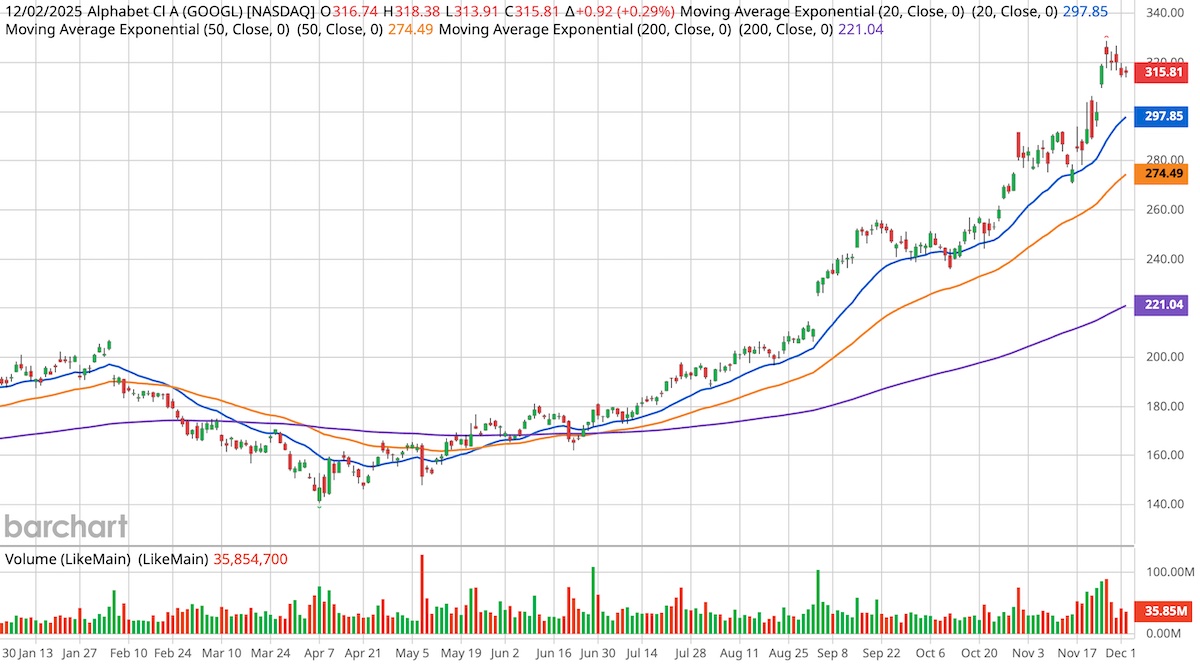
Since the November 18 debut of Gemini 3, a distinct rotation has occurred in the markets. Investors are fleeing the safety of the early leaders and piling into the companies powering Google’s resurgence. Alphabet stock has rallied as much as 14% since the Gemini 3 release, crushing its peers in the “Magnificent 7” throughout November.
The logic is sound. Google controls its entire stack, from the Gemini model down to the custom silicon that runs it—the Tensor Processing Units (TPUs). This vertical integration grants Google a structural cost advantage, allowing it to scale AI infrastructure without paying Nvidia’s premium. Consequently, shares of Broadcom (NASDAQ: AVGO), the manufacturing partner for Google’s custom chips, have surged 65% year-to-date.
Analysts at Wells Fargo (NYSE: WFC) noticed this decoupling immediately. In a note to clients, Chief Equity Strategist Ohsung Kwon highlighted that the market no longer views AI as a rising tide that lifts all boats. Instead, investors are placing specific bets on who owns the next generation of computing.
In a note to investors, Kwon wrote:
“Now, Gemini/TPU stocks trade at a premium relative to ChatGPT/GPU peers for the first time in nearly a decade — the market is saying GOOGL is winning the AI race.”
This sentiment is quantifiable. Nvidia, despite its massive year-to-date gains, dipped more than 2% this quarter. Microsoft, which holds a massive stake in OpenAI, has underperformed relative to Alphabet. The market smells a shift in technological leadership, and capital is flowing accordingly.
The Product Battle Intensifies
Financial speculation stems from product reality. For a long time, Google’s AI efforts felt like a disjointed game of catch-up. Gemini 3 changed that narrative overnight. The model boasts 650 million monthly active users, closing the gap with ChatGPT’s 800 million weekly users. But more importantly, the quality of the experience has shifted user loyalty.
Tech heavyweights are publicly defecting. Marc Benioff, the CEO of Salesforce (NYSE: CRM), did not mince words regarding his experience with the new model. His endorsement serves as a microcosm of the broader industry sentiment.
In an X post, Benioff wrote:
Holy shit. I’ve used ChatGPT every day for 3 years. Just spent 2 hours on Gemini 3. I’m not going back. The leap is insane — reasoning, speed, images, video… everything is sharper and faster. It feels like the world just changed, again. ❤️ 🤖 https://t.co/HruXhc16Mq
— Marc Benioff (@Benioff) November 23, 2025
Altman clearly hears the footsteps. The “code red” memo instructs staff to pause peripheral projects. OpenAI is pulling resources away from health initiatives, shopping features, and advertising plans. The mandate is clear: make ChatGPT smarter, faster, and more intuitive. They simply cannot afford to lose the core product battle while trying to build an empire of side hustles.
The competition extends beyond Google. Anthropic, backed by deep pockets from Amazon (NASDAQ: AMZN), is carving out a massive slice of the enterprise market. They grew their roster of large business customers, those spending over $100,000 annually, by seven times in just one year. OpenAI is squeezed between Google’s consumer ubiquity and Anthropic’s corporate reliability.
Even the hardware ecosystem is reacting. Samsung (OTC: SSNLF) moved quickly to integrate new AI features into its devices, outpacing Apple (NASDAQ: AAPL). In Cupertino, the pressure is mounting. Apple recently poached Amar Subramanya, a former Microsoft and Google executive, to serve as its new vice president of AI, hoping to accelerate a roadmap that currently delays major Siri improvements until 2026.
Global Rivals and Massive Burns
While Silicon Valley infighting grabs headlines, a new challenger has emerged from the East. DeepSeek, a Chinese AI company funded by the hedge fund High-Flyer, recently unleashed DeepSeek-V3.2. This model reportedly matches the capabilities of the best Western systems, including GPT-5 class models, specifically in reasoning and mathematics.
This development shatters the assumption that U.S. export controls on advanced chips would permanently cripple Chinese AI development. DeepSeek’s open-source approach allows developers worldwide to build agents that “think” and use tools, challenging the closed-garden ecosystems of OpenAI and Google.
This intensifying competition exacerbates OpenAI’s biggest vulnerability: its bank account. Unlike Google or Meta Platforms (NASDAQ: META), which enjoy bottomless cash flow from established advertising monopolies, OpenAI loses money on every query. They recently secured a $500 billion valuation and funding from backers like SoftBank (OTC: SFTBY), but the costs are astronomical.
Altman has committed to $1.4 trillion in infrastructure deals to secure the compute power necessary for future models. It is a gamble of historic proportions. He believes that running out of computing power poses a greater risk than overspending.
“This is the bet we are making, and given our vantage point, we feel good about it,” Altman wrote in a post regarding the infrastructure build-out.
However, patience is wearing thin. The company projects revenue to hit hundreds of billions by 2030, but right now, they face “temporary economic headwinds” and “rough vibes,” as Altman put it to his staff.
The reality is stark. Google has the cash, the chips, and now, the momentum. OpenAI has the brand name and the early lead, but in technology, three years is a lifetime. The “code red” is not just a motivational tactic; it is a recognition that the most valuable startup on earth is fighting for its life.
I would like to clarify a few things.
First, the obvious one: we do not have or want government guarantees for OpenAI datacenters. We believe that governments should not pick winners or losers, and that taxpayers should not bail out companies that make bad business decisions or…
— Sam Altman (@sama) November 6, 2025
AI Industry FAQ
What is AI in simple terms?
Artificial Intelligence (AI) refers to computer software designed to mimic human cognitive functions. By analyzing vast amounts of data, these systems identify patterns to predict outcomes, solve complex problems, and make decisions. Common applications include digital voice assistants, medical diagnostic tools, and content recommendation algorithms on streaming platforms.
Who invented AI?
AI wasn’t created by a single inventor but was developed through the collective work of many researchers. John McCarthy is widely credited as the “father of AI” for coining the term and organizing the pivotal Dartmouth conference in 1956. Other foundational figures include Alan Turing, who established the concepts of machine intelligence, alongside pioneers like Marvin Minsky, Herbert Simon, and Allen Newell.
What are the risks of AI?
The rapid advancement of AI brings several risks, ranging from immediate societal issues like algorithmic bias, the spread of misinformation, and privacy violations, to economic concerns such as job displacement. There are also broader safety fears regarding the potential loss of human control over autonomous systems, the development of autonomous weaponry, and the long-term existential risks if AI capabilities eventually far exceed human intelligence.
What are the top AI stocks?
The AI sector is dominated by “hyperscalers” and chip manufacturers. Key players include Nvidia (NVDA) for its essential GPU hardware, Microsoft (MSFT) for its software and cloud infrastructure, and Alphabet (GOOGL) for its deep integration of AI into search and data. Other significant stocks include Meta Platforms (META), Broadcom (AVGO) for custom silicon, Advanced Micro Devices (AMD), Oracle (ORCL), and data analytics firm Palantir (PLTR).
Who owns OpenAI?
OpenAI operates under a unique hybrid structure. The non-profit OpenAI Foundation owns a controlling interest in the board, while the commercial arm, OpenAI Group PBC, is owned by a mix of investors and employees. Microsoft is the largest corporate backer with a 27% stake. The remaining ownership is split between the Foundation (26%) and a group of employees and other investors (47%).
Who owns Anthropic?
Anthropic is an independent public-benefit corporation founded by former OpenAI executives, including siblings Dario and Daniela Amodei. While it remains independent, it has accepted substantial minority investments from major tech giants, most notably Amazon (AMZN) and Alphabet (GOOGL), alongside venture capital funding.
Who owns DeepSeek?
DeepSeek is the AI research subsidiary of High-Flyer, a prominent Chinese quantitative hedge fund. Both companies were founded and are led by Liang Wenfeng. Unlike many U.S. startups that rely on venture capital, DeepSeek is fully funded by the profits generated by High-Flyer’s trading algorithms.
Read Next: Space Stocks Rocket Higher on Reports of SpaceX’s Massive $1.5 Trillion Planned IPO
Join the Discussion in the WVC Facebook Investor Group
Do you have a stock tip or news story suggestion? Please email us at: invest@wealthyvc.com.
Disclaimer: Wealthy VC does not hold a position in any of the stocks, ETFs or cryptocurrencies mentioned in this article.